
You can deliver spotless work, keep clients happy, and build a great cleaning team. But if your sales pipeline goes quiet every few months, growth still feels like a guessing game. That’s the problem with relying on referrals alone. One month, everyone seems to know somebody who needs a cleaner. The next month, your phone acts like it has entered witness protection.
A commercial cleaning sales funnel gives you a repeatable path from finding potential customers to signing profitable contracts. It helps you see where deals are moving, where they’re stalling, and where your sales process may be quietly losing good opportunities.
What Is a Commercial Cleaning Sales Funnel?
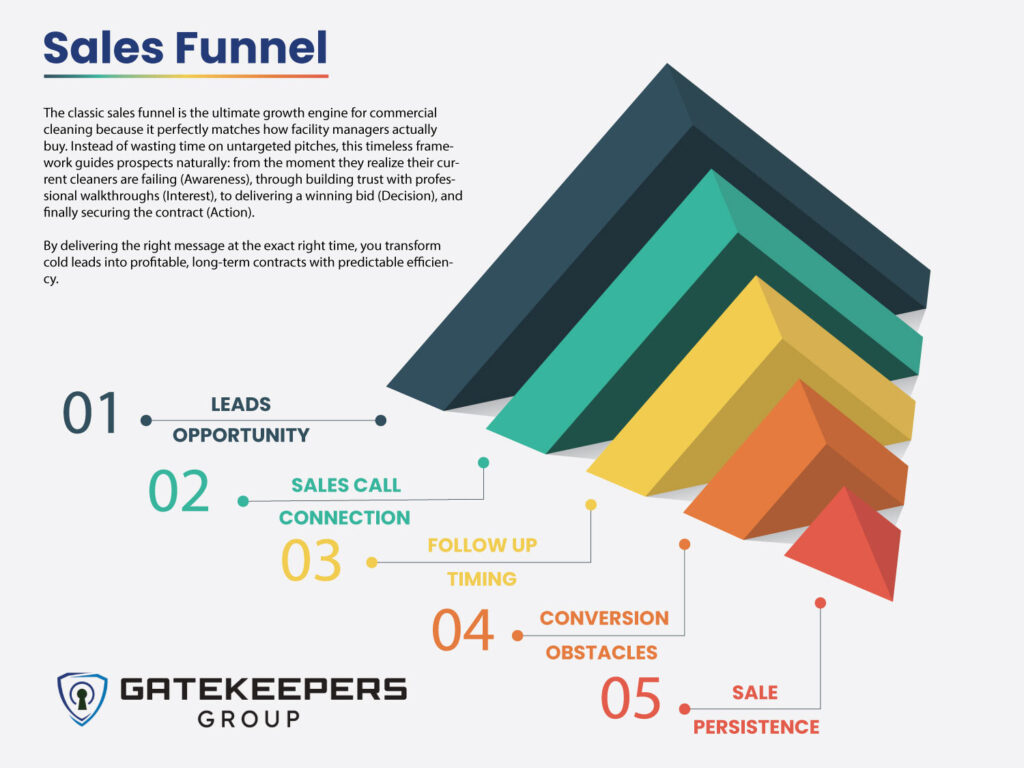
A commercial cleaning sales funnel is the process that moves a potential customer from initial outreach to a signed service agreement. At the top, you have businesses that might need your services. Some will become qualified prospects. A smaller group will agree to appointments or walkthroughs, and only the best-fit opportunities will become paying clients. A healthy funnel usually includes:
- Prospecting: Identifying businesses that match your service area, capabilities, and ideal account size
- Qualification: Confirming the facility, decision-maker, cleaning needs, timing, and contract potential
- Appointment setting: Getting a real conversation or walkthrough with someone who can influence the decision
- Site walkthrough: Learning how the property operates and what the prospect actually needs
- Proposal: Presenting a clear scope, schedule, price, and reason to choose your company
- Follow-up: Answering questions, addressing concerns, and keeping the decision moving
- Closing: Reaching an agreement, securing signatures, and preparing for a strong service launch
- Handoff and retention: Making sure the operations team delivers what sales promised
That final stage matters more than many owners realize. A contract isn’t truly a win if the account cancels three months later because your sales pitch and operational reality never met.
Stage One: Prospecting Leads for the Right Accounts
The top of your funnel shouldn’t contain every building with a front door. A small cleaning company may waste weeks pursuing hospitals, airports, or giant industrial contracts it isn’t staffed or insured to handle. On the other hand, chasing tiny accounts outside your service area can fill your schedule without adding much profit.
Good prospecting begins with fit. You need businesses that match your preferred facility type, geographic area, service capacity, and revenue goals. You also need the right contact. The person answering the main phone line may be helpful, but they probably aren’t choosing the next janitorial provider. Your real buyer may be a property manager, facility manager, business owner, office manager, procurement professional, or commercial real estate contact.
This is where many commercial cleaning companies get stuck. They’re great at cleaning buildings, not spending hours researching contacts and trying to get past gatekeepers. That’s exactly why specialized cleaning company appointment setting can be valuable. Your team gets more time to sell and operate while qualified outreach keeps happening in the background.
Stage Two: Qualifying Before You Call
Not every interested prospect deserves the same amount of your time. Qualification helps you determine whether the opportunity is real, profitable, and appropriate for your company. Does the business have a genuine need? Are you talking to someone involved in the decision? Is the property within your service area? Can your team meet the schedule and scope?
Timing matters too. A prospect may love your company but still be locked into another contract for eight months. That isn’t necessarily a dead lead. It may simply belong in a different part of your follow-up pipeline. Poor qualification creates a busy calendar full of meetings that never had much chance of becoming business. It feels productive right up until you check the sales numbers.
Stage Three: Turning Interest Into an Appointment
An appointment is where a name on a list becomes a real sales opportunity. The goal isn’t to pressure someone into a walkthrough they don’t want. It’s to reach a relevant decision-maker, uncover whether a cleaning problem exists, and determine whether a conversation makes sense. That sounds simple. It isn’t.
Commercial decision-makers are busy, skeptical, and contacted by plenty of cleaning companies. Generic messages about “high-quality service at competitive prices” tend to blend together because nearly every competitor says the same thing. Your positioning has to connect with the prospect’s actual concerns. Maybe their current provider misses details. Perhaps communication is poor, staffing is inconsistent, or complaints keep reaching management. The appointment becomes valuable when it is tied to a business problem, not just your desire to submit another quote.
Gatekeepers Group focuses on connecting commercial cleaning companies with actual decision-makers rather than handing them a pile of unqualified names. Because a spreadsheet with 500 contacts isn’t a sales pipeline. It’s homework.
The Site Walkthrough
The walkthrough is not just your chance to count toilets and measure floors. It’s where you learn what the prospect values and whether your company can deliver it profitably. Pay attention to the physical space, but also listen for frustration. Why are they considering a change? What has gone wrong with previous providers? Which areas generate the most complaints? Who evaluates service after the contract begins?
A rushed walkthrough often produces a weak proposal. If you miss access restrictions, floor conditions, supply responsibilities, security requirements, or service expectations, your price may look fine on paper while quietly setting you up to lose money. The prospect is evaluating you too. They’re noticing whether you ask thoughtful questions, understand commercial cleaning, and appear capable of managing the account. Walking through a facility with your face buried in a clipboard does not exactly scream trusted advisor.
Building a Proposal That Makes Sense
Your proposal should make the decision easier, not bury the prospect under ten pages of company history and stock photos of suspiciously cheerful people holding spray bottles. The buyer needs to understand what you will clean, how often you will clean it, what the service costs, and how you will manage quality. They also need confidence that you listened during the walkthrough.
Price matters, but it is rarely the only factor. A cheap proposal becomes far less attractive when the scope is vague, communication is unclear, or the provider seems likely to disappear after the first month. This stage also exposes deeper business problems. Are you pricing for profit or just trying to beat the current cleaner? Does your scope reflect what the customer requested? Can your operations team fulfill every promise?
If your proposals are getting attention but not signatures, the issue may not be your leads. Your offer, pricing, presentation, or sales conversation may need work. Business coaching for cleaning companies can help you identify where the breakdown is happening without forcing you through another round of expensive trial and error.
Stage Four: Following Up Without Disappearing or Becoming Annoying
A surprising number of cleaning companies submit a proposal, send one “just checking in” email, and then declare the prospect uninterested. Commercial decisions can take time. The buyer may be comparing proposals, waiting for budget approval, reviewing a current contract, or putting out five unrelated fires.
Professional follow-up keeps your company visible and gives the prospect a chance to ask questions. It also shows that you can communicate consistently, which matters when they’re considering trusting you with their facility. There’s a balance, of course. Following up does not mean calling every morning like you’re trying to collect a gambling debt. It means having a clear process, adding value to the conversation, and recognizing when an opportunity should be moved to a future date.
If deals repeatedly stall after the proposal, look closely at this stage. You may be failing to uncover objections, communicate value, or ask for a decision. Gatekeepers Group’s commercial cleaning contract training focuses on the stretch between the site walk and the final signature, where plenty of promising opportunities quietly die.
Stage Five: Closing the Sale and Handing Off the Account
Closing isn’t about delivering a dramatic final pitch. It’s about helping the right prospect feel confident enough to move forward. Before the agreement is signed, the customer should understand the scope, schedule, price, start date, supplies, communication process, and expectations on both sides. Ambiguity now becomes conflict later. Then comes the handoff to operations.
Sales cannot promise a flawless five-night service and quietly hand the account to a supervisor who only has staff for three nights. If the cleaning team doesn’t understand the scope or the customer’s priorities, the account begins with avoidable problems. Your sales funnel should end with a strong launch, not a signed document tossed over the wall.
Where Is Your Commercial Cleaning Sales Funnel Leaking?
If you aren’t getting enough appointments, you may have a prospecting, targeting, or outreach problem. If you book appointments but rarely reach the proposal stage, your qualification or walkthrough process may be weak. If you submit proposals but don’t close, look at pricing, presentation, follow-up, and how clearly you communicate value.
And if you’re winning contracts but losing clients quickly, stop blaming the sales funnel. You may have an operational or management problem. Are supervisors checking the work? Are cleaners following directions? Did sales promise something the team cannot realistically deliver? Or is the customer expecting work outside the agreed scope? Those aren’t comfortable questions, but comfortable questions don’t grow cleaning companies.
Commercial Cleaning Sales Funnel FAQs
1. What are the stages of a commercial cleaning sales funnel?
The main stages are prospecting, qualification, appointment setting, site walkthrough, proposal, follow-up, closing, and operational handoff. Tracking each stage helps you identify where opportunities are being lost.
2. Why do commercial cleaning proposals fail to close?
Proposals often fail because the opportunity was poorly qualified, the scope is unclear, the price doesn’t match the value, or follow-up is inconsistent. Sometimes the company simply contacted the prospect at the wrong time.
3. How can appointment setting help a cleaning company?
Appointment setting gives your company more opportunities to speak with relevant commercial decision-makers. It can reduce the time your sales team spends researching contacts, making cold calls, and chasing unqualified leads.
4. Who makes commercial cleaning purchasing decisions?
Depending on the property, the decision may involve a business owner, property manager, facility manager, office manager, procurement manager, or commercial real estate professional.
5. What should happen after a commercial cleaning contract is signed?
Sales should transfer the complete scope, schedule, customer priorities, access information, and service expectations to operations. A strong launch helps prevent early complaints and cancellations.
6. How do you know which part of the sales funnel is broken?
Track how many prospects move from one stage to the next. A sharp drop reveals the likely problem. Low appointment volume points toward prospecting, while many proposals and few wins suggest issues with pricing, presentation, or follow-up.
Stop Leaving Growth to Luck
You don’t need more random leads. You need a commercial cleaning sales funnel that consistently puts the right opportunities in front of you and makes it clear what happens next.
Gatekeepers Group helps commercial cleaning companies reach decision-makers, strengthen their sales process, and address the business problems standing between them and profitable growth. Start with the Gatekeepers Group assessment and find out where your company may be getting stuck.